Defining a new game
In this tutorial, we are going to define a game from scratch using Stratega’s YAML configuration. The objective is to create a combat game with two types of units, a fighter and cities. The fighter can move and attack. Meanwhile, the city passively produces one gold per turn and can spawn more fighters using the acquired gold.
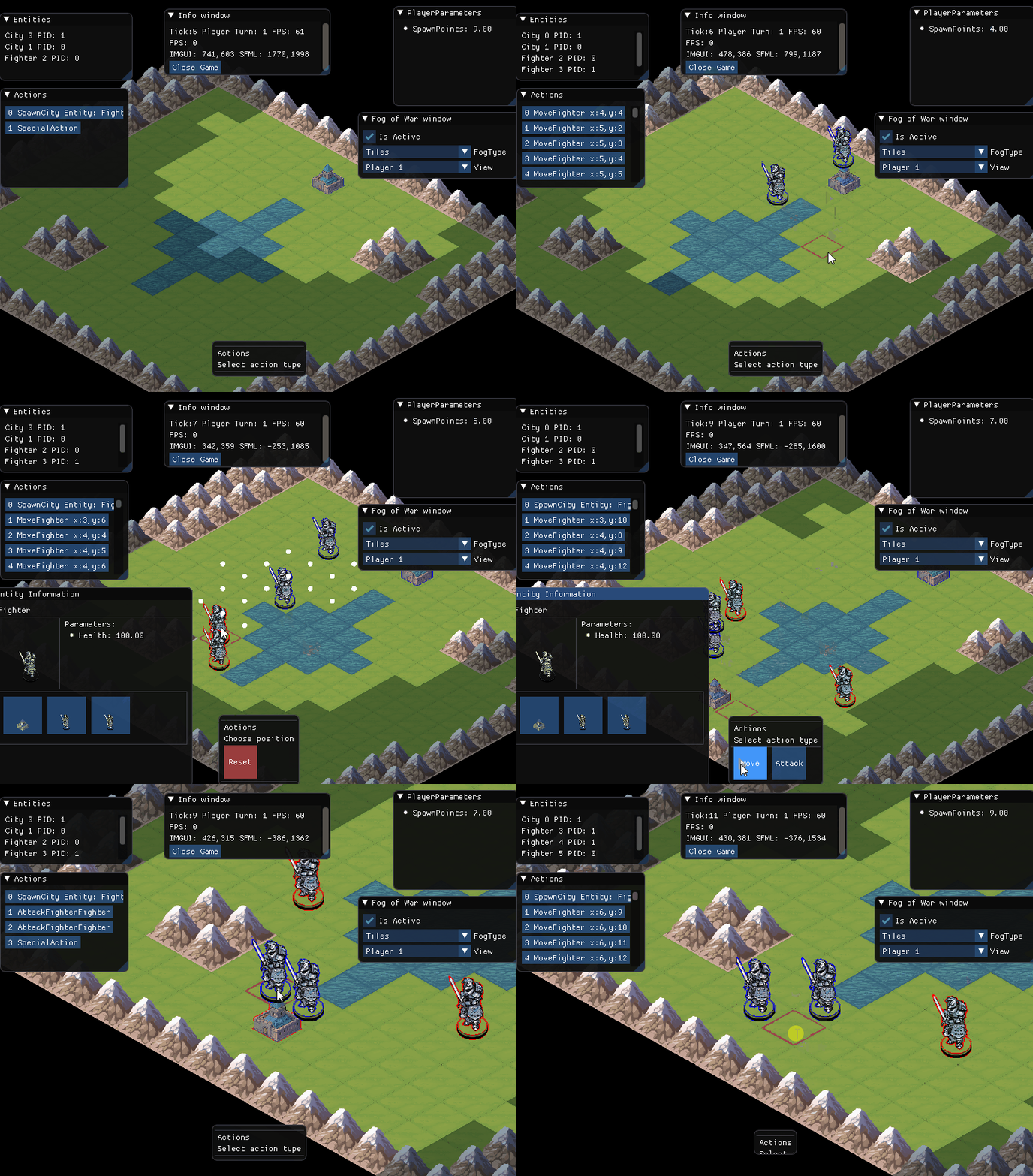
First, we define the type of the game, how much time an agent has per turn, and a limit on how long a game lasts. Once the round limit is reached, the game will end in a draw. While we are at it, we define the agents that should play the game.
GameConfig:
    Type: TBS
    ActionTimer: 10s
    RoundLimit: 100

Agents:
    - RandomAgent
    - HumanAgent
Next, we have to define the Game renderer configuration, with the resolution and the default assets used y the GUI.
GameRenderer:
    Resolution:
        Width: 800
        Height: 600
    Default Assets:
        FogOfWar: ../../assets/Tiles/notVisible.png
    GridIsIsometric: true
    TileSpriteOrigin:
        Width: 128
        Height: 112
    EntitySpriteOrigin:
        Width: 256
        Height: 360
    TileSpriteSize:
        Width: 256
        Height: 144
    EntitySpriteSize:
        Width: 512
        Height: 512
    #Optional:
    #Font: ../../assets/arial.ttf
    #OutlineShader: ../../assets/OutLine.frag
Next, we define that each player can store gold. We do this by assigning an additional parameter to the players which represents the currency.
Player:
    Parameters:
        Gold: 5
As the next step, we define the tiles that our map will contain. Plains are tiles that units can walk on, while water and mountain tiles will block the unit’s movement. To make a tile walkable, we just set the IsWalkable flag to true. Additionally, we want the mountains to block the view of units to allow for sneaky attacks, which is done by activating the BlocksSight flag. Finally, don’t forget to assign a symbol to each tile since we will later use it to draw the map.
Tiles:
    Plain:
        Sprite: ../../assets/Tiles/plain.png
        Symbol: .
        IsWalkable: true
        DefaultTile: true
    Water:
        Sprite: ../../assets/Tiles/water.png
        Symbol: W
        IsWalkable: false
    Mountain:
        Sprite: .../../assets/Tiles/rock.png
        Symbol: M
        IsWalkable: false
        BlocksSight: true
Before we can define the map, we also have to define the entities. Although buildings, units and vehicles are all quite different, in Stratega, they are all defined as an entity. Every entity needs a path to the sprite representing it, a symbol for drawing the map, and a value to specify how far it can see. For this game, we only define two entities. As with the gold parameter for players, we assign parameters to the entities to represent certain things; In this case, both entities get a health parameter. Additionally, we assign the actions and the cost for spawning the fighter, which we will discuss later.
Entities:
    City:
        Sprite: ../../assets/Entities/castle.png
        Symbol: c
        LineOfSightRange: 5
        CanSpawn: Fighter
        Actions: [Spawn]
        Parameters:
            Health: 100

    Fighter:
        Sprite: ../../assets/Entities/unit2.png
        Symbol: f
        LineOfSightRange: 6
        Actions: [Move, Attack]
        Parameters:
            Health: 100
            AttackDamage: 10
        Cost:
            Gold: 3
Now we are done with the tedious definitions, at least for a short moment. Now we can define the map using the symbols of the tiles and entities we defined earlier. To do this, draw a rectangular map and you are done. To place entities, replace a tile symbol with an entity symbol. The tile occupied by the entity will always contain the default tile (See the earlier definition of plains). Note that we can also assign entities to certain players by specifying a number after the entity symbol. If no number is specified, the entity will be neutral.
Board:
    GenerationType: Manual
    Layout: |-
        M  M  M  M  M  M  M  M  M  M  M  M  M  M  M  M  M
        M  M  .  .  .  .  .  .  .  .  .  .  .  .  .  M  M
        M  M  .  .  .  .  .  .  c1 .  .  .  .  .  .  M  M
        M  M  .  .  .  .  .  .  .  .  .  .  M  M  .  M  M
        M  M  .  .  .  .  .  .  W  .  .  .  M  M  .  M  M
        M  M  .  .  .  .  .  .  W  .  .  .  .  .  .  .  M
        M  M  .  .  .  .  .  W  W  W  .  .  .  .  .  .  M
        M  .  .  .  .  .  W  W  W  W  W  .  .  .  .  .  M
        M  .  .  .  .  .  .  W  W  W  .  .  .  .  .  .  M
        M  .  .  .  .  .  .  .  W  .  .  .  .  .  .  .  M
        M  M  .  .  M  M  .  .  W  .  .  .  .  .  .  M  M
        M  M  .  .  M  M  .  .  .  .  .  .  .  .  .  M  M
        M  M  .  .  .  .  .  .  c0 .  .  .  .  .  .  M  M
        M  M  .  .  .  .  .  .  .  .  .  .  .  .  .  M  M
        M  M  M  M  M  M  M  M  M  M  M  M  M  M  M  M  M
Now comes the complex part, defining the actions. To define an action, we have to specify what it can target and what effects the action will do.
There are many different things an action can target, below you can see a cutout of how to define targets. For this tutorial, we only need to target positions, entities as well as entity types. While targeting entities will refer to an existing entity on the board, an entity type references the definition of an entity. This is useful if we want to spawn something since we can just target an entity type. For each valid target that Stratega finds, one action will be generated at runtime. Since we restricted the entity type to only target fighters, there will be at most one action available. It could also happen that no action is available if the entities player can’t afford the fighters cost (See the previous fighter definition) or the entity executing this action cannot spawn fighters (See previous city definition).
The name assigned to each target is later used to specify conditions and effects. In this case, we have one target named “SpawnType”. If we had defined multiple targets, then the number of actions available is equal to the cross-product between all targets.
Targets:
    SpawnType:
        Type: EntityType
        ValidTargets: Fighter
        Conditions:
            - "CanAfford(Source.Player, Target)"
            - "CanSpawn(Source, Target)"
You may have noticed that the target name “SpawnType” indicates that we currently are defining the spawn action for the city. Below you can see how the full definition of spawn looks like. It has a cooldown of one tick, which means you can only execute it once per turn in turn-based games. Whenever an entity executes this action, it will spawn the fighter in a random spot around the source (city) and subtract the fighters cost (3 gold) from the players’ gold count.
Spawn:
    Type: EntityAction
    Cooldown: 1
    Targets:
        SpawnType:
            Type: EntityType
            ValidTargets: Fighter
            Conditions:
                - "CanAfford(Source.Player, SpawnType)"
                - "CanSpawn(Source, SpawnType)"
    Effects:
        - "SpawnRandom(Source, SpawnType)"
        - "PayCost(Source.Player, SpawnType)"
Next, we have the attack action. Note that the attack reduces an entities health by explicitly referencing the previously defined parameter. The effect “Attack” then reduces the parameter by the value of the parameter AttackDamage plus a constant value of 5 points and a random number given from the dice anotation 2d10, and if it falls below 0, removes the attacked entity from the game. Since Stratega does not prevent you from defining an entity without health, make sure that it can never be targeted by an attack. Otherwise, the game has to be stopped by Stratega due to an unresolvable error.
Attack:
    Type: EntityAction
    Cooldown: 1
    Targets:
        Target:
            Type: Entity
            ValidTargets: [Fighter, City]
            Conditions: # Only target entities with a distance of 1 to whoever executes this action
                - "InRange(Source, Target, 1)"
    Effects:
        - "Attack(Target.Health, Source.AttackDamage+5+2d10)"
Now we are nearly done. Below you can find the complete list containing all actions, including the move action. This action does nothing new, except that it targets a position.
Actions:
    Spawn:
        Type: EntityAction
        Cooldown: 1
        Targets:
            SpawnType:
                Type: EntityType
                ValidTargets: Fighter
                Conditions:
                    - "CanAfford(Source.Player, SpawnType)"
                    - "CanSpawn(Source, SpawnType)"
        Effects:
            - "SpawnRandom(Source, SpawnType)"
            - "PayCost(Source.Player, SpawnType)"

    # Attack Actions
    Attack:
        Type: EntityAction
        Cooldown: 1
        Targets:
            Target:
                Type: Entity
                ValidTargets: [Fighter, City]
                Conditions: # Only target entities with a distance of 1 to whoever executes this action
                    - "InRange(Source, Target, 1)"
        Effects:
            - "Attack(Target.Health, Source.AttackDamage+5+2d10)"


    # Move Actions
    Move:
        Type: EntityAction
        Cooldown: 1
        Targets:
            Target:
                Type: Position
                Shape: Circle
                Size: 3
                Conditions:
                    - "IsWalkable(Target)"
        Effects:
            - "Move(Source, Target)"
The last thing we have to do is define the win- & loss conditions of the game. We can also assign effects to specific events in the game. For example, we define the condition that the player who loses his city will lose this game. Finally, we can specify that each city on the board produces one gold whenever a tick has passed. A tick in turn-based games is equivalent to all players having played once, or in not overly complicated words: it’s our definition of a turn.
ForwardModel:
    LoseConditions: #If true: Player -> cant play
        HasNoCity:
        - "HasNoEntity(Source, City)"

    Trigger:
    - OnTick:
        ValidTargets: City
        Conditions:
            - "IsPlayerEntity(Source)"
        Effects:
            - "ModifyResource(Source.Player.Gold, 1)"
And we are done! Below you can see the full definition of the YAML file. Feel free to experiment and have a look at the YAML-Documentation. to see what else Stratega can do!
Full yaml
GameConfig:
    Type: TBS
    ActionTimer: 10s
    RoundLimit: 100

GameRenderer:
    Resolution:
        Width: 800
        Height: 600
    Default Assets:
        FogOfWar: ../../assets/Tiles/notVisible.png
    GridIsIsometric: true
    TileSpriteOrigin:
        Width: 128
        Height: 112
    EntitySpriteOrigin:
        Width: 256
        Height: 360
    TileSpriteSize:
        Width: 256
        Height: 144
    EntitySpriteSize:
        Width: 512
        Height: 512
    #Optional:
    #Font: ../../assets/arial.ttf
    #OutlineShader: ../../assets/OutLine.frag

Agents:
    - RandomAgent
    - HumanAgent

Player:
    Parameters:
        Gold: 5

Tiles:
    Plain:
        Sprite: ../../assets/Tiles/plain.png
        Symbol: .
        IsWalkable: true
        DefaultTile: true
    Water:
        Sprite: ../../assets/Tiles/water.png
        Symbol: W
        IsWalkable: false
    Mountain:
        Sprite: ../../assets/Tiles/rock.png
        Symbol: M
        IsWalkable: false
        BlocksSight: true

Actions:
    Spawn:
        Type: EntityAction
        Cooldown: 1
        Targets:
            SpawnType:
                Type: EntityType
                ValidTargets: Fighter
                Conditions:
                    - "CanAfford(Source.Player, SpawnType)"
                    - "CanSpawn(Source, SpawnType)"
        Effects:
            - "SpawnRandom(Source, SpawnType)"
            - "PayCost(Source.Player, SpawnType)"

    # Attack Actions
    Attack:
        Type: EntityAction
        Cooldown: 1
        Targets:
            Target:
                Type: Entity
                ValidTargets: [Fighter, City]
                Conditions:
                    - "InRange(Source, Target, 1)"
        Effects:
            - "Attack(Target.Health, Source.AttackDamage+5+2d10)"


    # Move Actions
    Move:
        Type: EntityAction
        Cooldown: 1
        Targets:
            Target:
                Type: Position
                Shape: Circle
                Size: 3
                Conditions:
                    - "IsWalkable(Target)"
        Effects:
            - "Move(Source, Target)"

Entities:
    City:
        Sprite: ../../assets/Entities/castle.png
        Symbol: c
        LineOfSightRange: 5
        CanSpawn: Fighter
        Actions: [Spawn]
        Parameters:
            Health: 100

    Fighter:
        Sprite: ../../assets/Entities/unit2.png
        Symbol: f
        LineOfSightRange: 6
        Actions: [Move, Attack]
        Parameters:
            Health: 100
            AttackDamage: 10
        Cost:
            Gold: 3


Board:
    GenerationType: Manual
    Layout: |-
        M  M  M  M  M  M  M  M  M  M  M  M  M  M  M  M  M
        M  M  .  .  .  .  .  .  .  .  .  .  .  .  .  M  M
        M  M  .  .  .  .  .  .  c1 .  .  .  .  .  .  M  M
        M  M  .  .  .  .  .  .  .  .  .  .  M  M  .  M  M
        M  M  .  .  .  .  .  .  W  .  .  .  M  M  .  M  M
        M  M  .  .  .  .  .  .  W  .  .  .  .  .  .  .  M
        M  M  .  .  .  .  .  W  W  W  .  .  .  .  .  .  M
        M  .  .  .  .  .  W  W  W  W  W  .  .  .  .  .  M
        M  .  .  .  .  .  .  W  W  W  .  .  .  .  .  .  M
        M  .  .  .  .  .  .  .  W  .  .  .  .  .  .  .  M
        M  M  .  .  M  M  .  .  W  .  .  .  .  .  .  M  M
        M  M  .  .  M  M  .  .  .  .  .  .  .  .  .  M  M
        M  M  .  .  .  .  .  .  c0 .  .  .  .  .  .  M  M
        M  M  .  .  .  .  .  .  .  .  .  .  .  .  .  M  M
        M  M  M  M  M  M  M  M  M  M  M  M  M  M  M  M  M

ForwardModel:
    LoseConditions: #If true: Player -> cant play
        HasNoCity:
        - "HasNoEntity(Source, City)"

    Trigger:
    - OnTick:
        ValidTargets: City
        Conditions:
            - "IsPlayerEntity(Source)"
        Effects:
            - "ModifyResource(Source.Player.Gold, 1)"