Implementing One Step Look Ahead
This section shows how to implement an agent (One Step Look Ahead; OSLA) that uses the following components required for Statistical Forward Planning agents (i.e. Monte Carlo Tree Search and Rolling Horizon Evolutionary Algorithms). In particular, OSLA uses:
Copies of a game state.
Advancing the game state forward with an action.
Evaluating a state with a heuristic function.
The idea behind One Step Look Ahead is simple: given the current state and the list of all possible N actions that can be run from that point, OSLA tries all actions to reach the respective N next states:
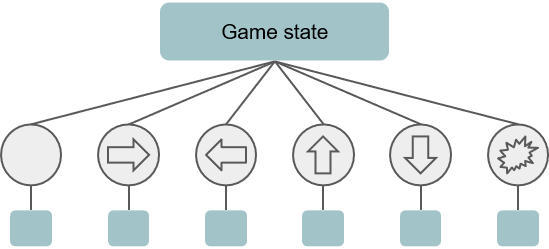
Each one of the subsequent states is then evaluated to obtained a (numerical) value of its quality. The objective is to identify which is the best state found according to a heuristic / evaluation of the features of the state. Finally, the action that led to state with the highest value is returned to the game to be played next.
Using C++
In order to implement this agent, first we setup the agent as indicated at the start of the Implementing Simple AI Agents tutorial (this is: generate a class that inherits from “Agent”, override the computeAction function and finally register the agent in the AgentFactory::getDefaultFactory() method to be able to test it.
The first step to implement OSLA is (in computeAction) to compute all available actions from the current state. The tools to do this are passed by parameter to the computeAction method: the GameState and the ForwardModel objects. The function generateActions in ForwardModel can be used as indicated in the following snippet, which also runs through all actions in the returned list:
#include <Stratega/Agent/MyAgent/MyAgent.h>
namespace SGA
{
    ActionAssignment MyAgent::computeAction(GameState state, const ForwardModel& forwardModel, Timer timer)
    {
        std::vector<Action> actionSpace = forwardModel.generateActions(state, getPlayerID());
        for (int i = 0; i < actionSpace.size(); i++)
        {
        }
    }
}
generateActions also receives a player ID, the one from the player for whom actions must be generated. The ID of the current player can be obtained by using “getPlayerID()”, as described in the Agents and Game States section.
The next step is to advance the state with each one of these actions. The ForwardModel advanceGameState function receives a game state object and an action. This function executes that action in the game state received, modifying the game state that is passed by parameter. Given that we can only advance the state (and not go back), we also need to make a copy of the current state, for each new action we want to try. Copying a game state is simple, as we can just the copy constructor of C++.
The following two lines create a copy of the object “state”, named “gsCopy”, and passes it to the forward model to advance it with an action:
GameState gsCopy(state);
forwardModel.advanceGameState(gsCopy, actionSpace.at(i));
The next step would be to evaluate the state once it has been advanced with an action. We can do this with any function we consider appropriate. Let’s assume we use the following which rewards states with a short average distance between the player’s entities and the opponent’s:
double evaluateState(GameState& state, int playerID)
{
    double score = 0.0;
    std::vector<Entity> opponentEntites = state.getNonPlayerEntities(playerID);
    std::vector<Entity> playerEntities = state.getPlayerEntities(playerID);

    if (state.isGameOver() && state.getWinnerID() == playerID) score = 1000;
    else if (state.isGameOver() && state.getWinnerID() != playerID) score = -1000;

    double sumOfAverageDistances = 0;
    for (const auto& p : playerEntities)
    {
        double sumOfDistances = 0;
        for (const auto& o : opponentEntites)
            sumOfDistances += abs(p.x() - o.x()) + abs(p.y() - o.y());

        sumOfAverageDistances = sumOfDistances / opponentEntites.size();
    }
    score += sumOfAverageDistances / playerEntities.size();

    return -score;
}
and we can use this function after advancing the game state:
GameState gsCopy(state);
forwardModel.advanceGameState(gsCopy, actionSpace.at(i));
double value = evaluateState(gsCopy, getPlayerID());
The only thing missing now is to include the logic that keeps a reference to the action with the highest evaluation score, and returns it at the end. The complete computeAction function would look as follows:
std::vector<Action> actionSpace = forwardModel.generateActions(state, getPlayerID());

int bestActionIndex = 0;
double bestHeuristicValue = -std::numeric_limits<double>::max();
for (int i = 0; i < actionSpace.size(); i++)
{
    GameState gsCopy(state);
    forwardModel.advanceGameState(gsCopy, actionSpace.at(i));
    double value = evaluateState(gsCopy, getPlayerID());
    if (value > bestHeuristicValue)
    {
        bestHeuristicValue = value;
        bestActionIndex = i;
    }
}

return ActionAssignment::fromSingleAction(actionSpace.at(bestActionIndex));
Of course, this agent is not very strong as the heuristic function does not consider the complexities of a full strategy game - hence more carefully thought evaluation functions may certainly be needed. Additionally, one step further may not be sufficient to allow for the actions to make a bigger impact in the game, so OSLA’s look ahead is clearly short-sighted. This tutorial only shows the basic components of these agents, which are just enough to build more complex agents such Monte Carlo Tree Search, Rolling Horizon Evolutionary Algorithms or Portfolio methods.
Using Python
Note
Inside src/python/agents is a python script with a set of pre-implemented agents an the minimal code to run gui/arena using the included gameconfigurations of the python module
In order to implement this agent, first we setup the agent as indicated at the start of the Implementing Simple AI Agents tutorial (this is: generate a class that inherits from “Agent”, override the computeAction function.
The first step to implement OSLA is (in computeAction) to compute all available actions from the current state. The tools to do this are passed by parameter to the computeAction method: the GameState and the ForwardModel objects. The function generate_actions in ForwardModel can be used as indicated in the following snippet, which also runs through all actions in the returned list:
class OSLAPythonAgent(stratega.Agent):
    def computeAction(self, state, forward_model, timer):
        for index, action in enumerate(actions):
           #...
generate_actions also receives a player ID, the one from the player for whom actions must be generated. The ID of the current player can be obtained by using “get_player_id()”, as described in the Agents and Game States section.
The next step is to advance the state with each one of these actions. The ForwardModel advance_gamestate function receives a game state object and an action. This function executes that action in the game state received, modifying the game state that is passed by parameter. Given that we can only advance the state (and not go back), we also need to make a copy of the current state, for each new action we want to try. Copying a game state is simple, as we can just the deepcopy method of the python copy lib .
The following two lines create a copy of the object “state”, named “gsCopy”, and passes it to the forward model to advance it with an action:
gs_copy = copy.deepcopy(state)
forward_model.advance_gamestate(gs_copy, action)
The next step would be to evaluate the state once it has been advanced with an action. We can do this with any function we consider appropriate. Let’s assume we use the following which rewards states with a short average distance between the player’s entities and the opponent’s:
def evaluate_state(state, player_id):
    score=0.0
    opponent_entites=state.get_non_player_entities(player_id, stratega.EntityCategory.Null)
    player_entites=state.get_player_entities(player_id, stratega.EntityCategory.Null)

    if state.is_game_over() and state.get_winner_id() == player_id:
        score=1000
    elif state.is_game_over() and state.get_winner_id() != player_id:
        score=-1000

    sum_of_average_distances = 0
    if not player_entites:
        for p in player_entites:
            sum_of_distances=0
            for o in opponent_entites:
                sum_of_distances+= abs(p.x()-o.x())+ abs(p.y()-o.y())

            sum_of_average_distances=sum_of_distances/len(opponent_entites)

    if not player_entites:
        score += sum_of_average_distances/len(player_entites)

    return -score
and we can use this function after advancing the game state:
gs_copy = copy.deepcopy(state)
forward_model.advance_gamestate(gs_copy, action)

value=evaluate_state(gs_copy, self.get_player_id())
The only thing missing now is to include the logic that keeps a reference to the action with the highest evaluation score, and returns it at the end. The complete computeAction function would look as follows:
class OSLAPythonAgent(stratega.Agent):
    def computeAction(self, state, forward_model, time_budget_ms):
        actions = forward_model.generate_actions(state, self.get_player_id())
        best_heuristic_value=-float("inf")
        best_action_index=0

        for index, action in enumerate(actions):
            gs_copy = copy.deepcopy(state)
            forward_model.advance_gamestate(gs_copy, action)

            value=evaluate_state(gs_copy, self.get_player_id())

            if value > best_heuristic_value:
                best_heuristic_value = value
                best_action_index = index
        action=actions.__getitem__(best_action_index)
        action_assignment=stratega.ActionAssignment.from_single_action(action)
        return action_assignment
Of course, this agent is not very strong as the heuristic function does not consider the complexities of a full strategy game - hence more carefully thought evaluation functions may certainly be needed. Additionally, one step further may not be sufficient to allow for the actions to make a bigger impact in the game, so OSLA’s look ahead is clearly short-sighted. This tutorial only shows the basic components of these agents, which are just enough to build more complex agents such Monte Carlo Tree Search, Rolling Horizon Evolutionary Algorithms or Portfolio methods.